




Le Buatte di Carmelina
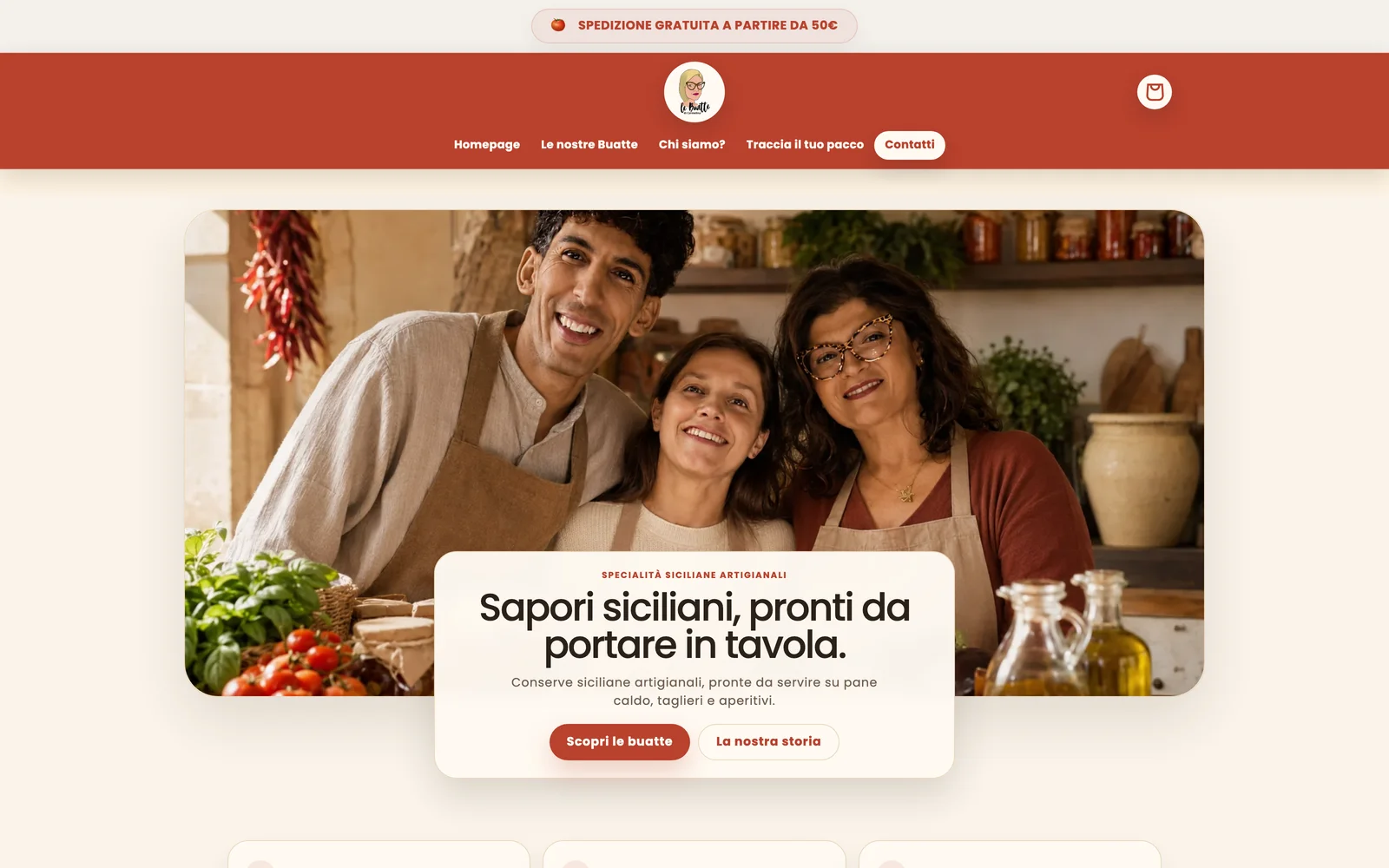
Sicilian artisan preserves: an online shop built on a family story.
Services · E-commerce
I build online shops for businesses. Your customer chooses, pays and gets the confirmation on their own, even when you are closed.
The price depends on what you sell: you tell me, and I tell you the whole figure before we start.
What I work with
Every online shop includes these six things.
Products, categories and variants put in order, so a customer finds what they are after in two steps instead of five.
Written to help people decide: what it is, how it is made, what it costs, how long it takes to arrive. The questions they would ask you face to face.
Payment methods set up and couriers connected, with costs and times the customer sees before the basket, not after.
No more orders scattered between WhatsApp, Instagram and voice notes: they all land in the same panel, with the history behind them.
I create it, or fix the one you have: someone searching your name has to find the business, not just the online shop.
Changes to the shop and fixes are on me. From the second year the price is agreed per job.
Sicilian artisan preserves: an online shop built on a family story.

An earphone shop I built myself: model picker designed from scratch.
If you don’t need to sell online, you need a brochure site first
There’s no public price: a shop with twelve products and one with eight hundred are two different jobs, and a single figure would be a fake one.
The platform to build it on is something I choose after understanding what you sell and how much of it has to be yours, not before.
How many products, how many variants, whether you ship yourself or already have a courier.
When I can, I build a piece of your shop and send it to you. Otherwise I open up a job that looks like it, instead of describing it to you.
What it includes, what it costs, in what order things happen. Free and with no commitment, and you read it having already seen what we are talking about.
There’s no right platform in the abstract, there’s the right one for your shop. I explain it to you before we start, not after.
You customise less: some things are done its way. In exchange, payments, shipping, invoices and security are already solved. A fee every month, always.
You customise far more: if the way you sell does not fit the usual moulds, here it fits. In exchange the initial work is longer. No monthly fee: hosting and domain remain.
With few products and a straightforward sale, Shopify gets you to the first order sooner. With a complicated catalogue, or when the shop has to live inside a site that does other things too, WordPress is the better fit.
Which of the two suits you, I tell you after seeing what you sell, and I tell you why as well.
1 · They choose
Your product
€48.00
In stock · shipped in 48 hours
Your customer sees the photo, the price and the availability, and decides on their own.
1 · They choose
Your product
€48.00
In stock · shipped in 48 hours
Your customer sees the photo, the price and the availability, and decides on their own.
2 · The cart
Shipping cost and total are written up front, not at the end.
3 · The payment
Card, PayPal or whatever you prefer: set up and connected.
4 · The confirmation
Order confirmed
Order 1043 · €54.00
Your customer gets the confirmation without you answering a message.
5 · It arrives
Your customer sees where the parcel is on their own: they do not message you to ask.
Press ‘Add to cart’ and try the buying journey for yourself.
It’s a simulation, not a client’s real shop.
In 2026
The customer you’re missing often doesn’t know the name of the product they need, so that name is never going to be typed anywhere. They know the problem, and they describe the problem exactly as it is, to ChatGPT or to Gemini: ‘there is a stain on my wooden floor, what do I put on it?’
And the answer doesn’t stop at the advice: it goes all the way to the link of a shop that has that product. To pick one, the machine compares the product pages, with what the thing is for, what size it is, what it costs and whether it’s in stock. If yours live only inside the photos on a social profile there’s nothing to compare, and the product in that answer belongs to another shop.
I write the product pages myself, one by one, with the information people actually decide on. A catalogue written that way works three times over: for the customer who has to choose, for Google, and for whoever is answering with AI.
It depends on what you sell and on how much of it has to be yours. Shopify is more closed on customisation, but it has already solved payments, shipping, invoices and security, and you pay a fee every month. WordPress can be customised far more, but the machinery has to be put together piece by piece and costs more work at the start. A shop written from scratch only makes sense when you sell in a way neither of the two allows for: that happens rarely, and when it does, I tell you.
It depends on how many products you have, how many variants each one has and how complicated the shipping is. A shop with ten products and one with eight hundred are two different jobs. I give you one figure after you’ve told me what you sell, and that figure holds: no costs appear halfway through.
Yes, that’s the whole point. I leave you a panel where you add products, change prices and see orders without calling me. At launch I stay alongside you: we do the first batch of products and the first test order together, so you see every step once. After that I’m here if you need a hand, but you’re not tied to me.
Yes, and it’s often the better move. Starting with ten well looked after products, with proper photos and descriptions, works better than loading a hundred half done. The shop grows afterwards: adding products is the easy part. Better to go out early with a little, done properly, than to wait six months for the full catalogue.