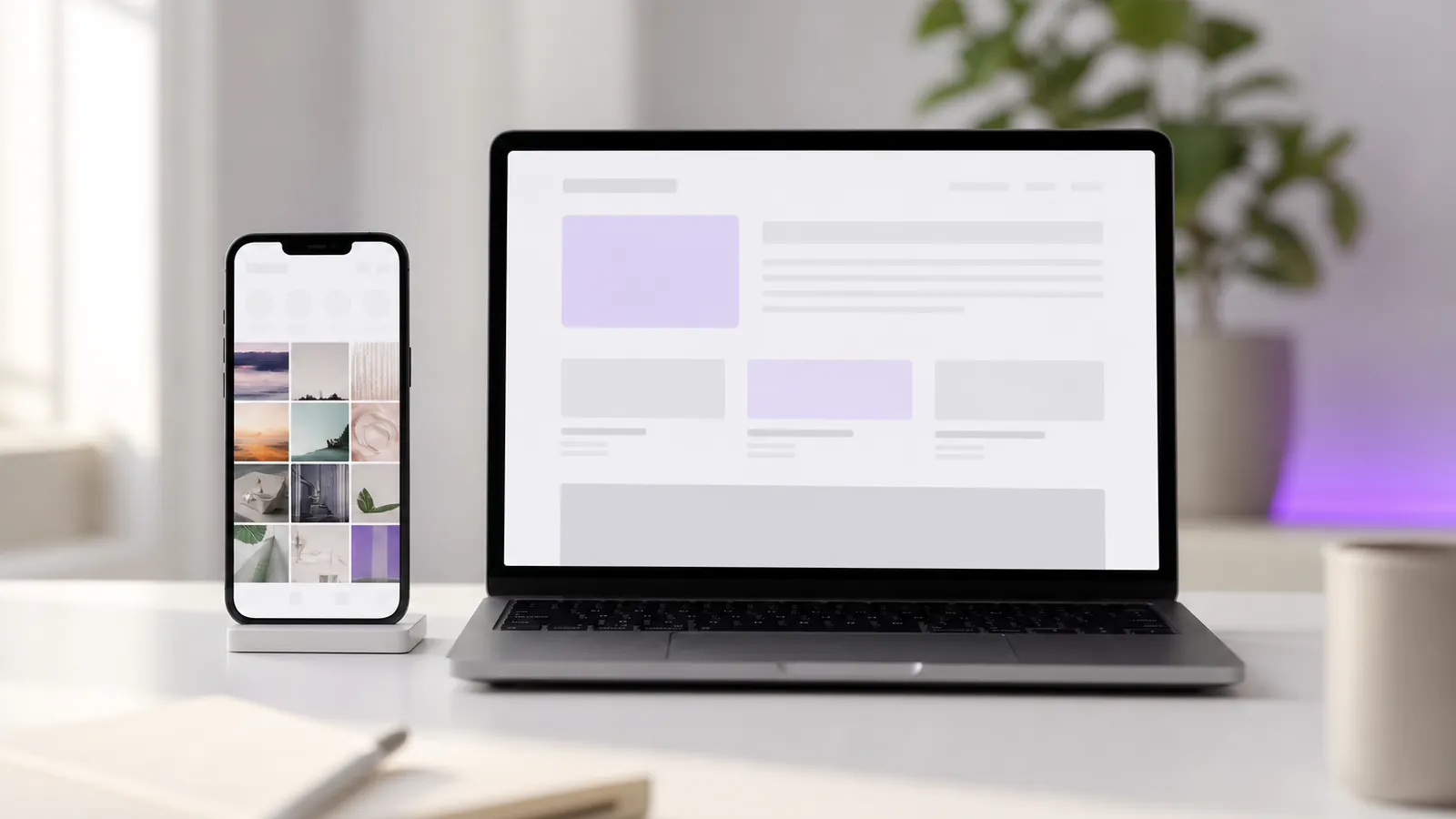
This is the question I get most often, usually with a half challenge in it: “I already have Instagram and Facebook, do I really need a site?”.
I will answer straight away, so I do not make you scroll for nothing: sometimes you do not. There are businesses for which social media is enough, at least for now, and that comes from someone who sells websites. But there are precise situations in which not having a site is costing you customers, and those situations can be recognised from the outside.
What you will not find here is the “social media is dead” speech. It is not true, and whoever says it usually has a site to sell you.
What Instagram does brilliantly, and should be kept for
Let us start with what social media does better than any website.
It gets you found by people who were not looking for you. That is the hardest thing in the world and social media does it for free. No website will put you in front of somebody who did not know they wanted you.
It shows the work while it happens. The half built job, the plate leaving the kitchen, the car changing colour. It is content you make with the phone in your pocket, and on a website it would feel unnatural.
It gets you talking to people. Comments, direct messages, question stickers. That is a relationship a website cannot build.
So if Instagram is working for you, the answer is not to drop it. Nobody is asking you to choose: they are two tools with two different jobs.
If you have decided the site is worth it, here is how I build one and what it costs.
Websites for businessesWhere Instagram is not enough
There are four things social media does not do, though, and all four weigh exactly at the moment the customer has to get the money out.
The profile is not yours. It is rented. The rules change when they decide, reach drops without warning, and an account can be locked or stolen. It happens, and the people it happens to lose years of content and contacts overnight, with nowhere to pick up the pieces. A website does not play that trick on you, because the address is in your name.
On Google, nobody finds you. People still search for a trade and a place together, an electrician and the name of their town, in exactly those words. Social profiles surface sometimes, but that is not their job and you cannot steer them. If somebody is looking for exactly what you do, in the place where you do it, and you are not there, they are calling somebody else. You do not need to imagine how many they are: it is enough that there are some.
There is nowhere to explain the serious things. Rough prices, what a service includes, how the guarantee works, where you are and when you are open. On a profile all of that either sits in a post buried three months back, or nowhere at all, and the customer asks you again in private. Every time.
The person who decides does not always follow you. If you work with other companies, the person who signs is often not the one scrolling: it can be an owner in his sixties, a purchasing manager, a technical office. That person judges you by opening a link on a computer, probably while comparing three suppliers in three browser tabs. If yours is a profile and the other two have a website, you start behind before anyone has spoken.
The moment of the link
There is one precise moment where you find out whether you need a site, and it has nothing to do with marketing.
It is when a serious customer, one with a budget who is deciding, says: “can you send me something?”.
What do you send?
If you send the Instagram profile, that person opens the app, sees a grid of photos and has to work out on their own what you do, whether you are equipped for their case and whether they can trust you. And if they then have to pass it on to a partner or a manager, that person receives a link to a social profile and forms an idea of you in three seconds, and it is not the idea you wanted.
If you send a link to your site, that person opens a page that tells them about the work in the right order, with the references, the cases, the contacts. It reads in a minute and it is still there tomorrow.
It is exactly why I work the way I do: when I propose a site to somebody, I send them one already built to look at, instead of describing it. The link does a job words do not. If you want to see the effect, here is the work I have done for businesses like yours.
When you do NOT need a site
Now the part you do not usually read on an agency website.
If you have just opened and you are still working out what you sell. A site photographs a business: if the business is still changing shape every couple of months, wait. First find your groove, then write it down.
If you are already full and not taking new customers. I know plenty who are. If you have work booked until spring and you do not want to grow, a website does not solve a problem you do not have. If anything it creates one: people to say no to.
If you sell to two or three companies that already know you. Some suppliers do very well on a handful of long standing clients. There what counts is the relationship, not the shop window.
If you have nothing to put in it. A site with three badly written lines and two blurry photos does more harm than good. Better nothing than that. In that case the first job is the photos, not the site.
If you only work on tenders and public contracts. If your customers are public bodies and the work arrives through a call, what counts is requirements, certifications and documents filed on time. A site there serves to exist and little else: other things come first.
If you recognised yourself in one of these, keep your social profiles and sleep easy. The opposite holds too, though: if you recognised yourself in the chapter about the link, the moment is now.
How to make them work together
If you decide to do both, they work well with a simple division of labour.
Social attracts, the site convinces.Instagram gets today’s work, your face, the behind the scenes. The site gets what people need in order to decide: what exactly you do, for whom, how working with you goes, roughly what it costs, how to write to you.
The link in the bio leads to the site, not to nothing. It is the simplest piece and almost nobody does it properly. Somebody who lands on the profile and wants to go deeper has to find a road, not a dead end.
The site keeps what social loses. The frequent questions, the rough prices, the long explanation: written once on the site, then sent when needed instead of being rewritten.
The site is the part that stays. If the algorithm changes tomorrow, if a profile gets locked, if a platform loses its grip the way others already have, you still have an address of your own with your work inside it.
If you cannot tell which side you are on
The most honest test I know is this: think of the last important customer you won, and of what you sent them when they asked for information. If what you had was enough, you are fine. If you wrote three long messages explaining things you wished were already written down somewhere, that somewhere is a website.
If you are in the second case, write to me and tell me what you do: I will tell you what is worth putting in and what is not, and what it would come to. If you would rather get a sense of the cost first, I have written all of it down in how much a website costs, mine included.
And if after talking I work out that the site is not for you, I will tell you. It has happened before.

Giacomo Baldan
I build websites, online shops and AI tools, from Mira near Venice, in Italy, since 2021. I write down here the things I explain to clients out loud, so you can read them before you write to me.
Read next
How much does a website cost a business in 2026?
The price brackets you find on the market, what makes the number move, and what a site costs with me. Real figures, mine included.

AI automation for small businesses: where to start
Four processes almost every company starts from, three things I actually built, and an honest answer about cost.
Want to talk about your own case?
Tell me what your business does and what you are weighing up. You get me, and there is no commitment.